CARE · Cooperative Action–Response Belief Estimation

Before We Act

Learning Action-Conditioned Team-Response Beliefs for Decentralized Multi-Robot Manipulation

Zihao Li1,2, Yanan ZHOU1, Ranpeng Qiu2, Guoqiang Ren2, Weiming Zhi1,*

1The University of Sydney  2Zeno AI

*Corresponding author: Weiming Zhi

Preprint · 2026

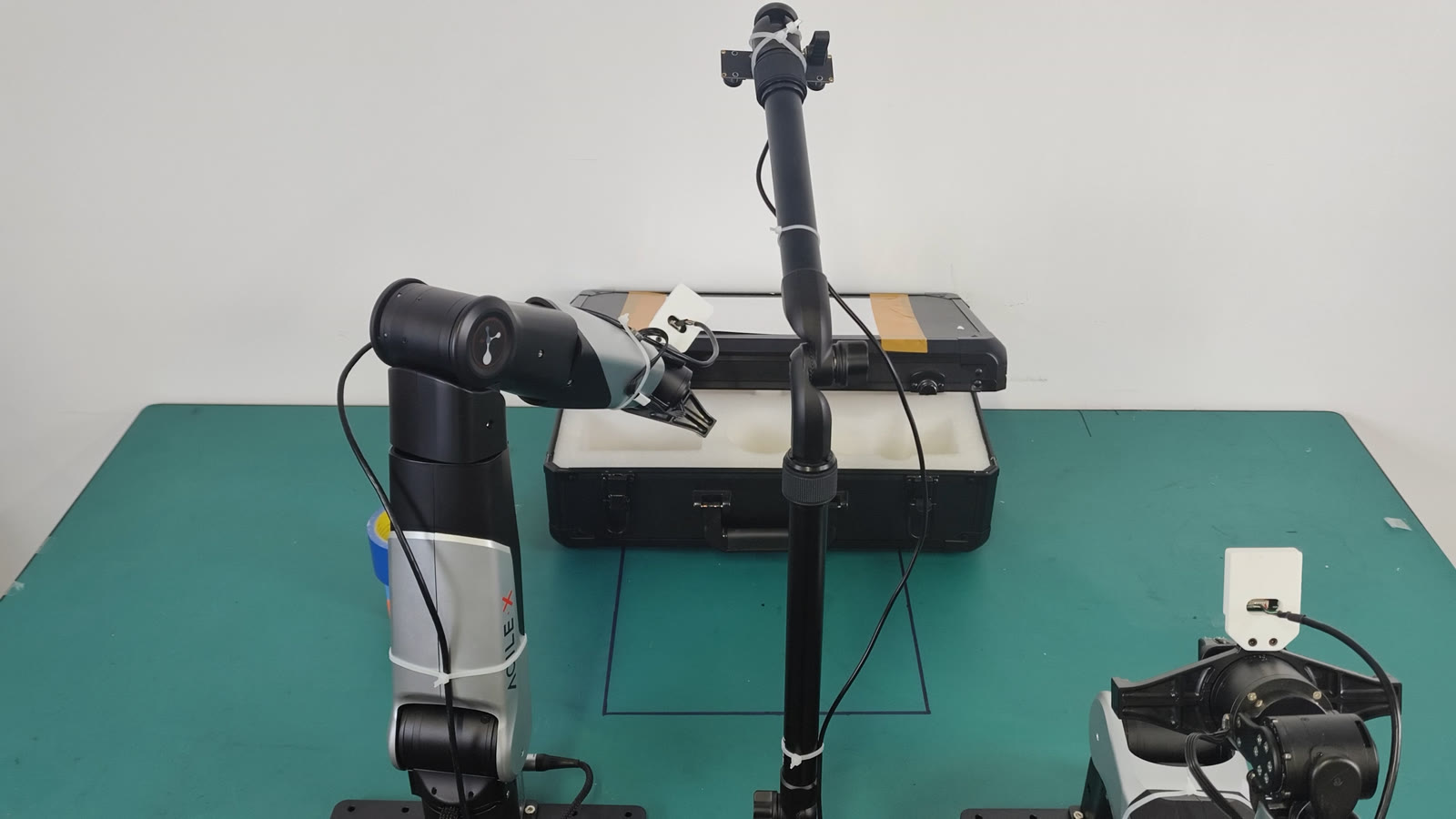
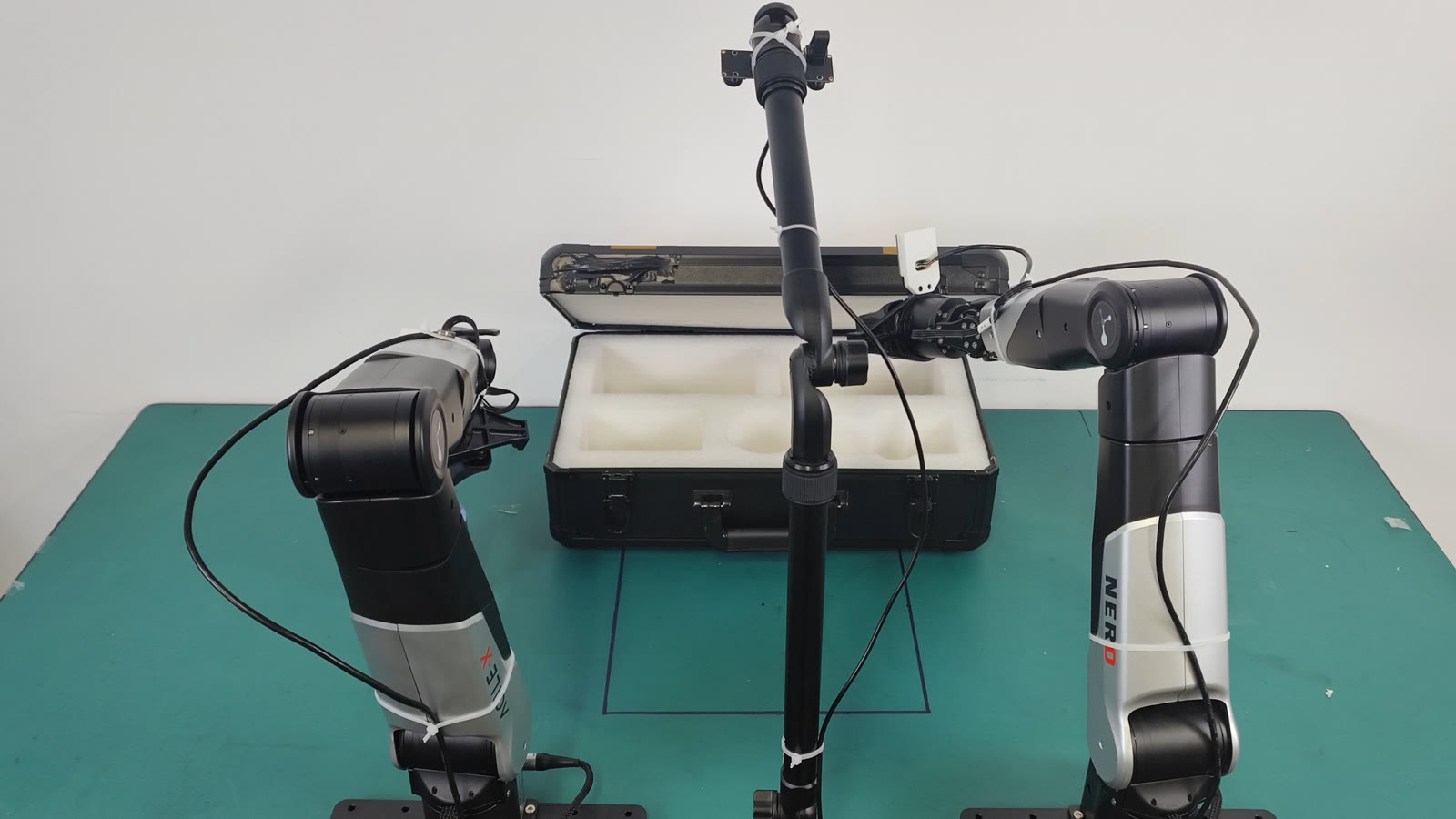
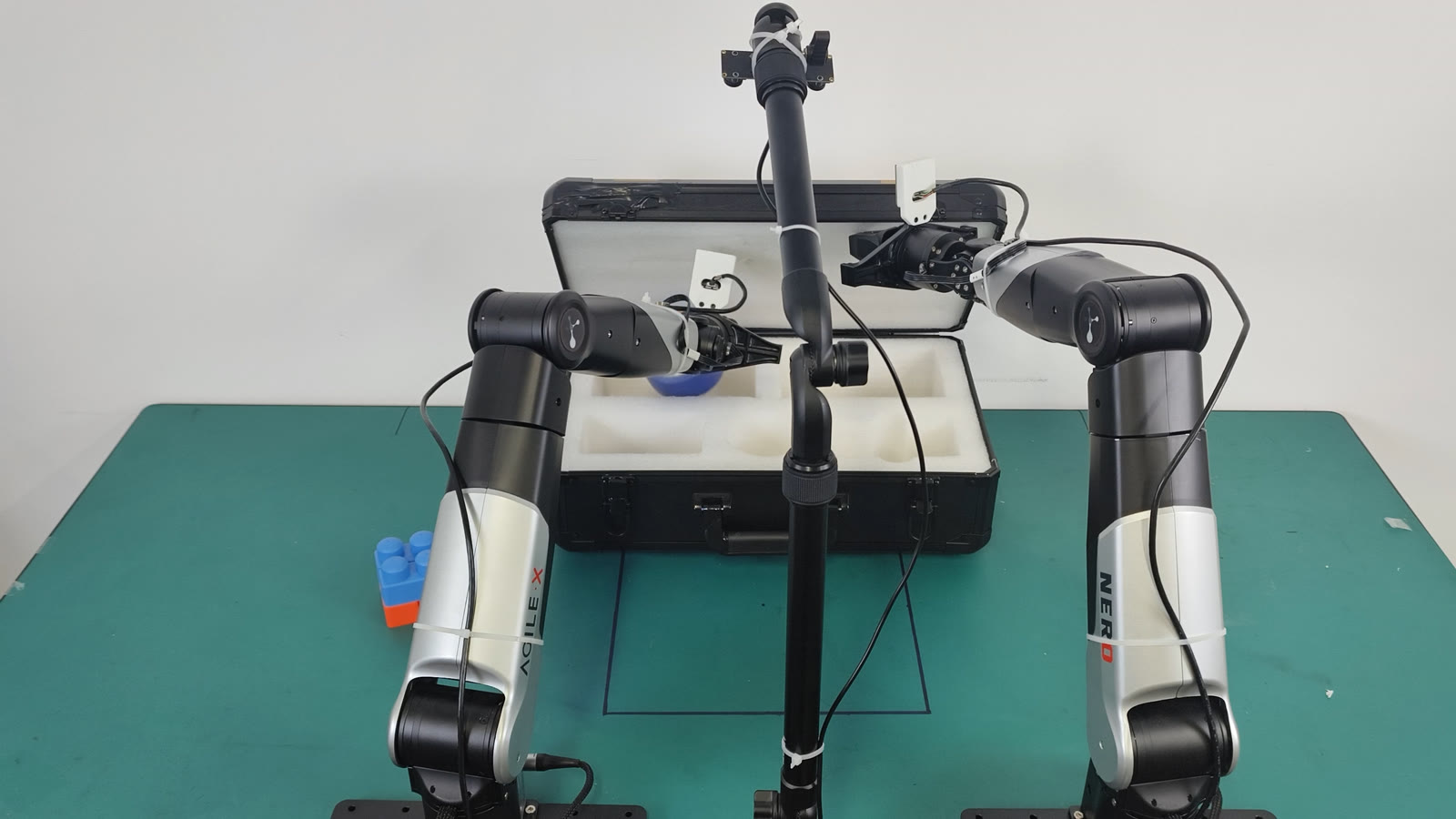
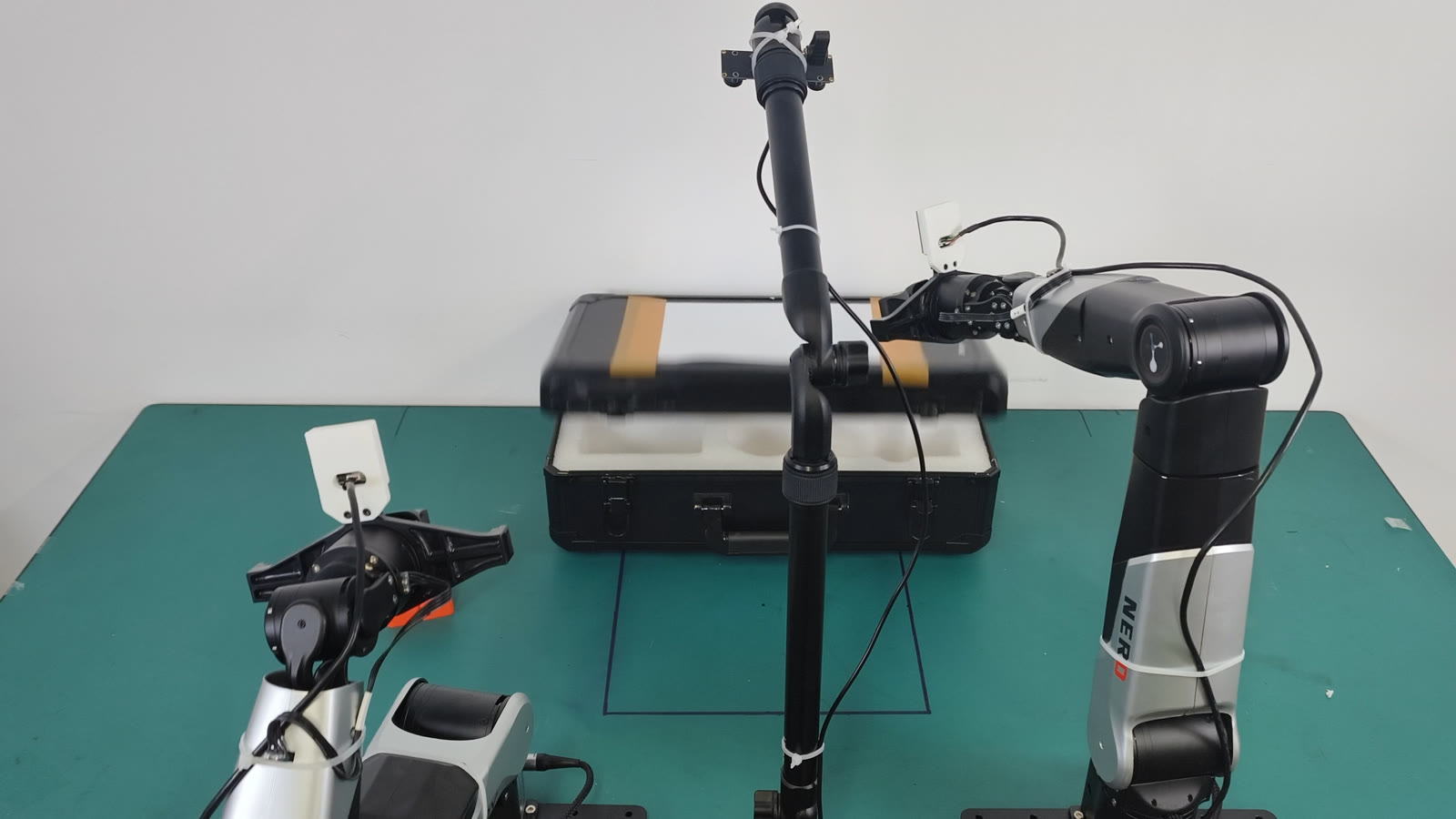
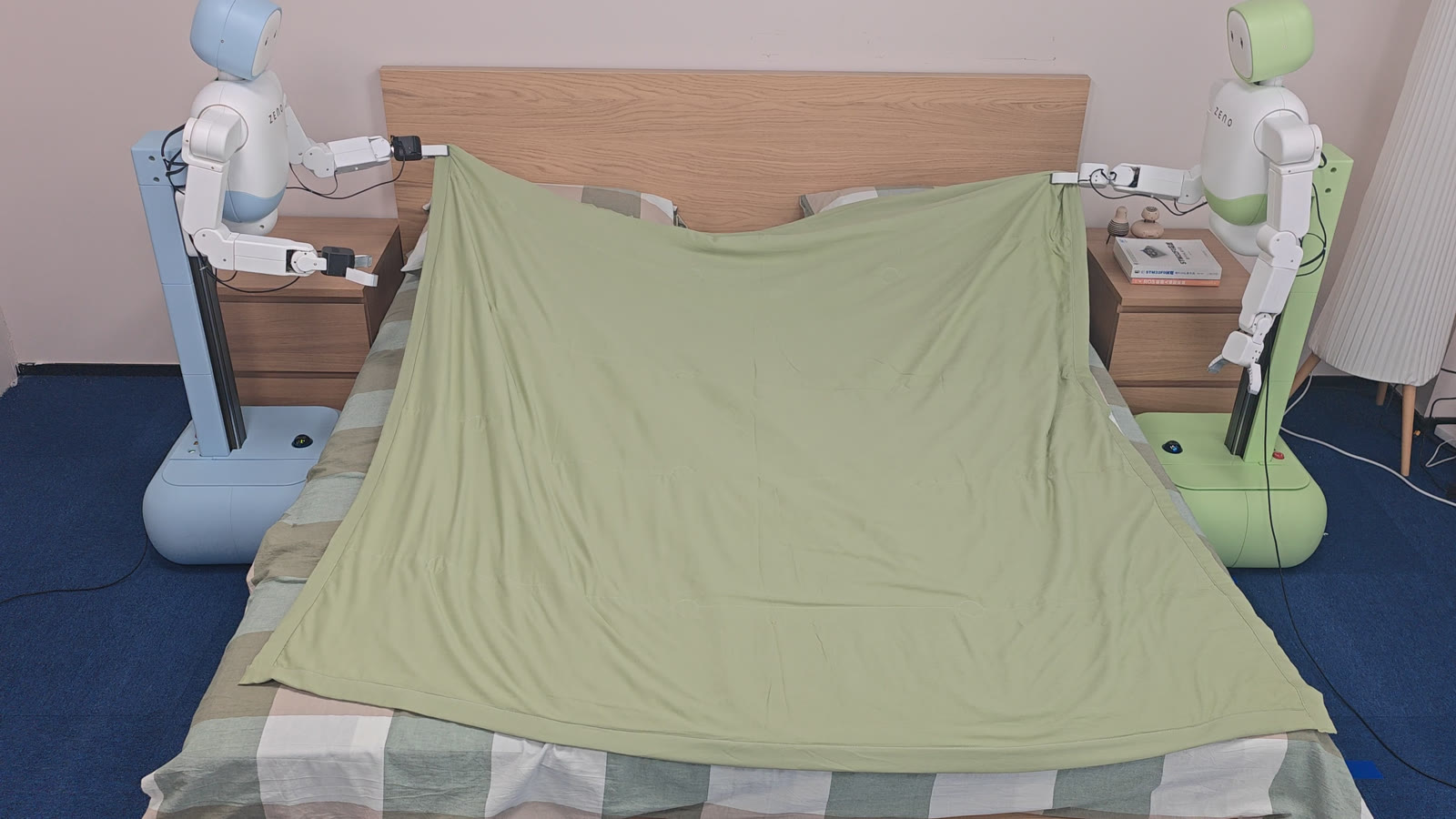
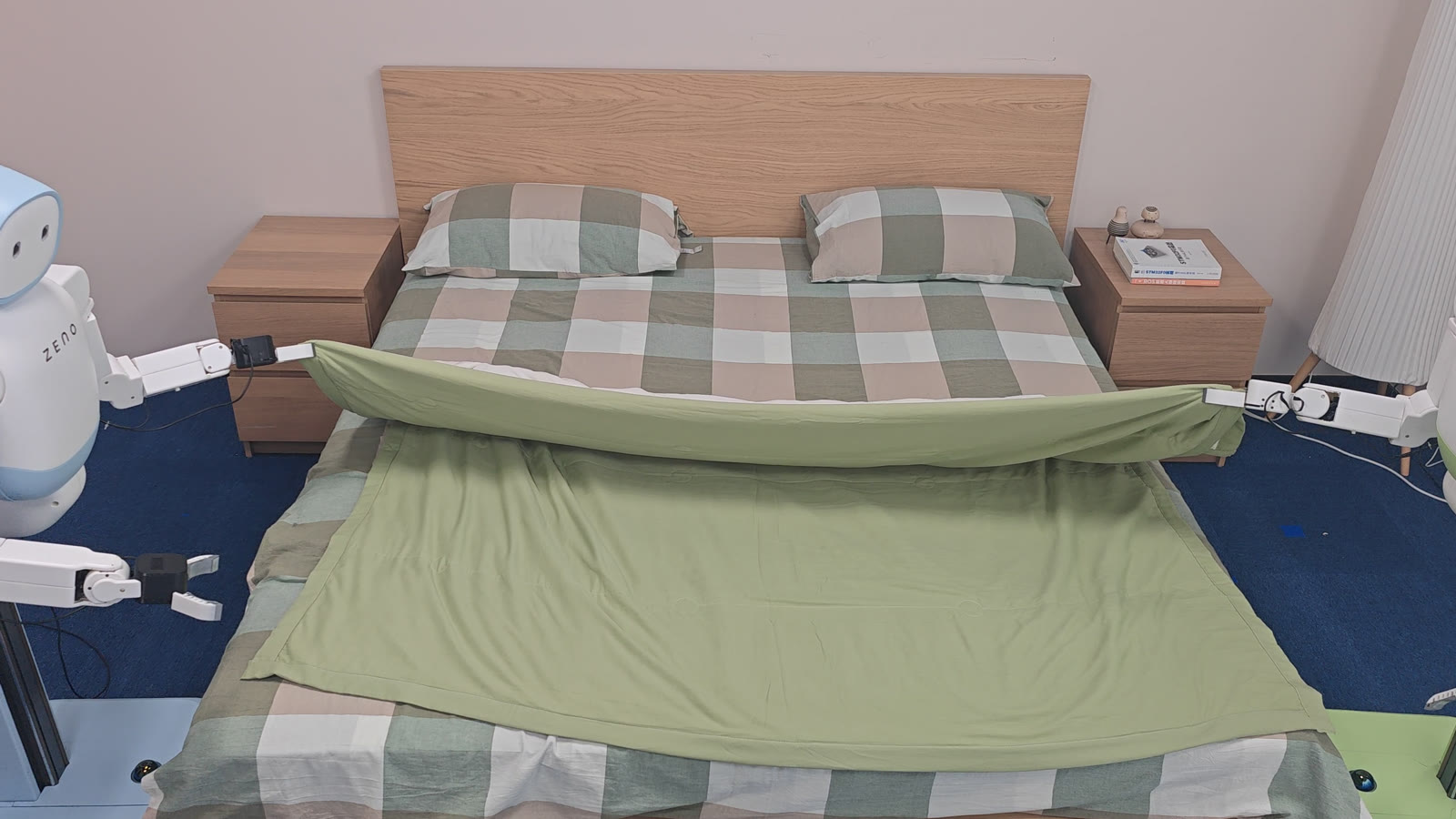
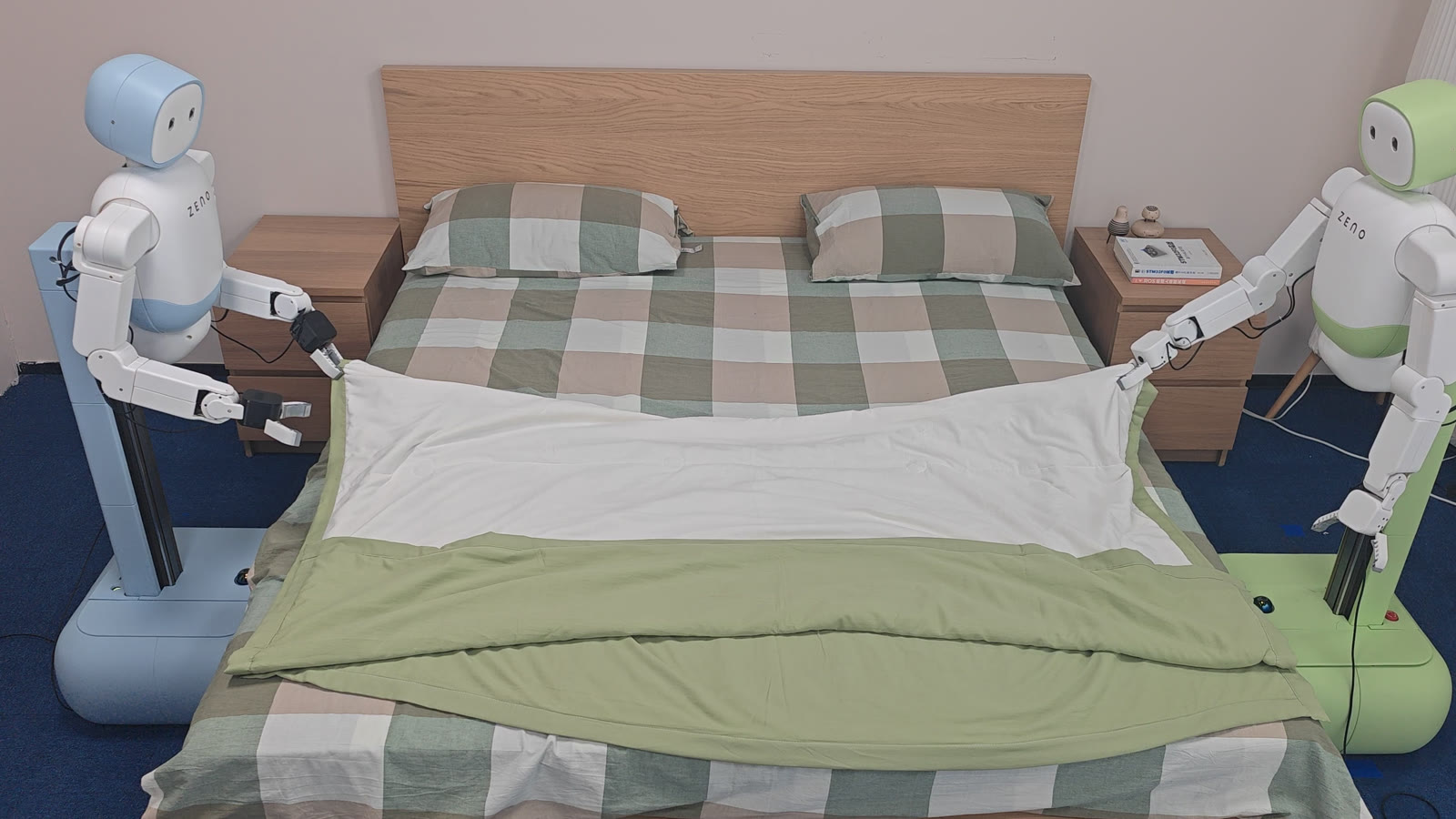
Folding Bed · physical dual-robot task Both robots run the same CARE policy from their own camera and joint history. The blue robot holds the quilt edge and waits while the green robot regrasps.

Whether an action is useful often depends on how teammates respond to it. CARE predicts that response before acting, from local history alone.

RoboFactory · six collaborative tasks

85.8%

+13.3 over LatentToM, the best collaboration-specific baseline

Physical dual-robot tasks · 40 trials

92.5%

+35.0 percentage points over π0.5

Nominal action overridden

6%

of control steps, recovering half of the available headroom

Overview

The best action depends on what the teammate will do next.

Consider two robots carrying an object. One of them has to decide when to turn. Turning now shortens its own path, but it can destabilize the object if the partner is still regrasping. Waiting briefly makes little direct progress, yet it lets the partner finish the grasp so the team can proceed. The uncertainty that matters is what the team will do in response to the next action. The same decision arises when releasing an object in a handoff, yielding a shared workspace, or synchronizing a lift.

We call a robot's prediction of this action-dependent effect a team-response belief. For each candidate action, it describes the likely gain or loss in team utility that comes from letting teammates adapt, compared with teammates that keep their nominal behavior. It is conditioned on the candidate action, inferred from the robot's own history, and keeps its uncertainty. It needs no semantic label such as "the partner is ready" and no reconstruction of the partner's hidden intent.

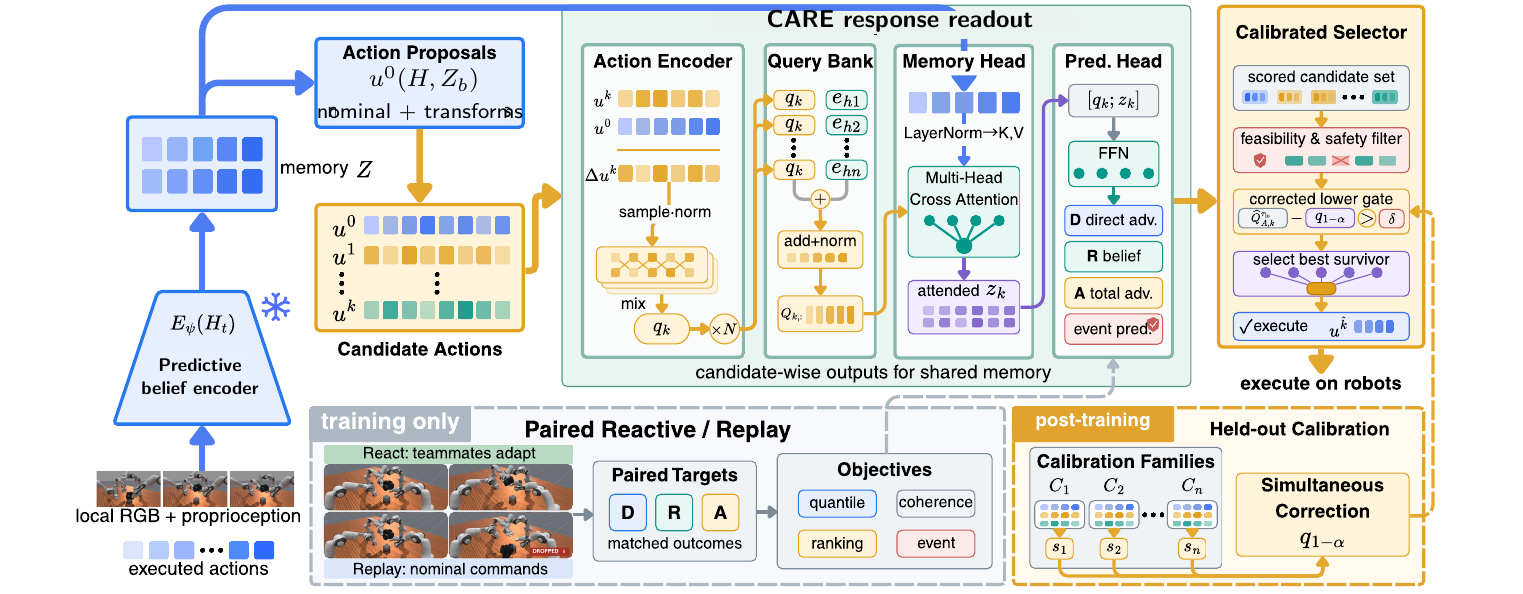
Ordinary demonstrations provide almost no supervision for this belief. A successful trajectory shows the action that was taken and the response that followed, but nothing about how teammates would have responded to the alternatives. CARE (Cooperative Action–Response Belief Estimation) makes the response contribution an explicit training target through paired interaction augmentation, learns a predictive belief encoder that conditions nominal actions, then trains a candidate-conditioned response readout with the encoder and action generator frozen. Calibrated selection chooses an alternative or retains the nominal action at execution.

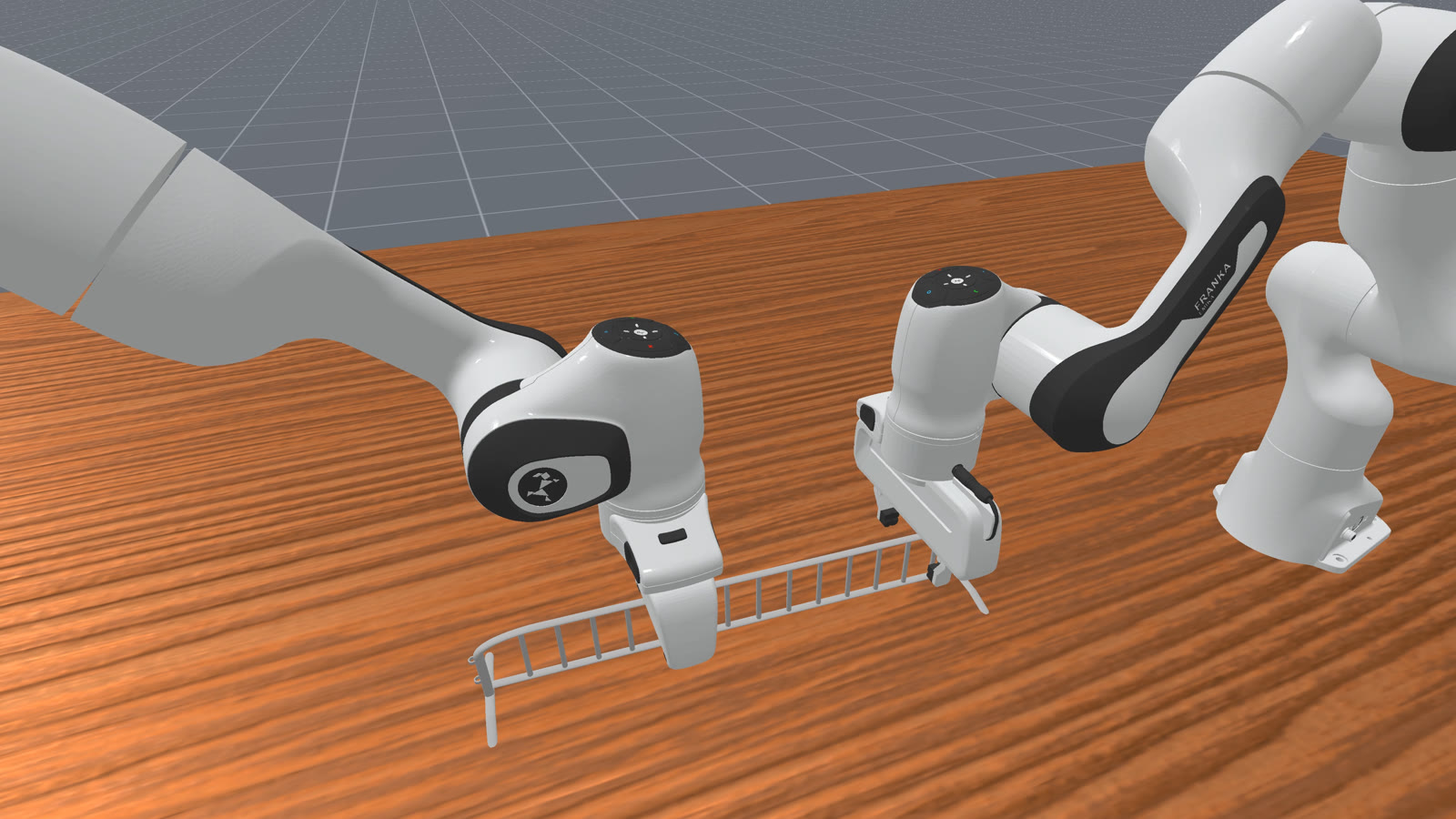
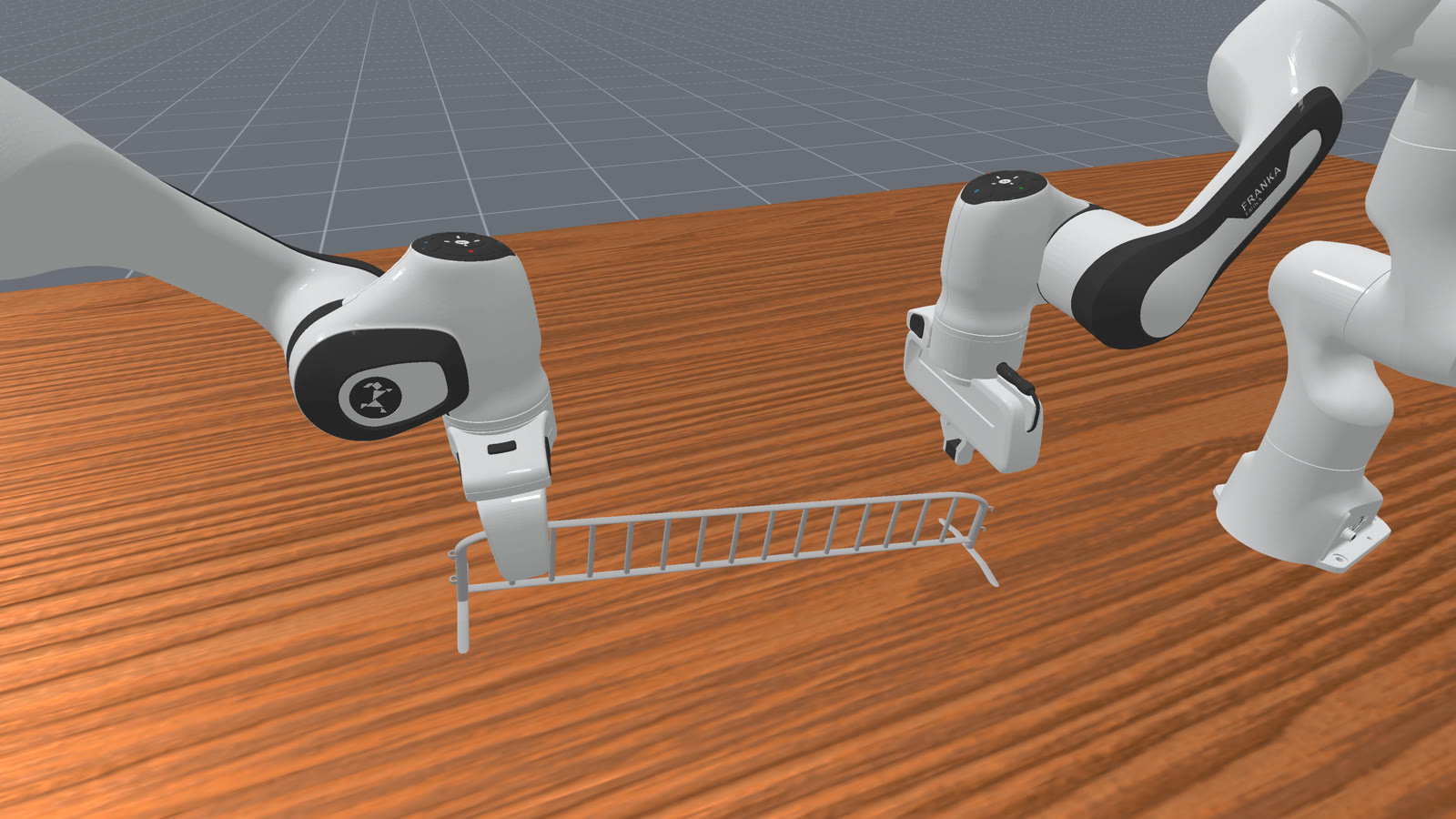
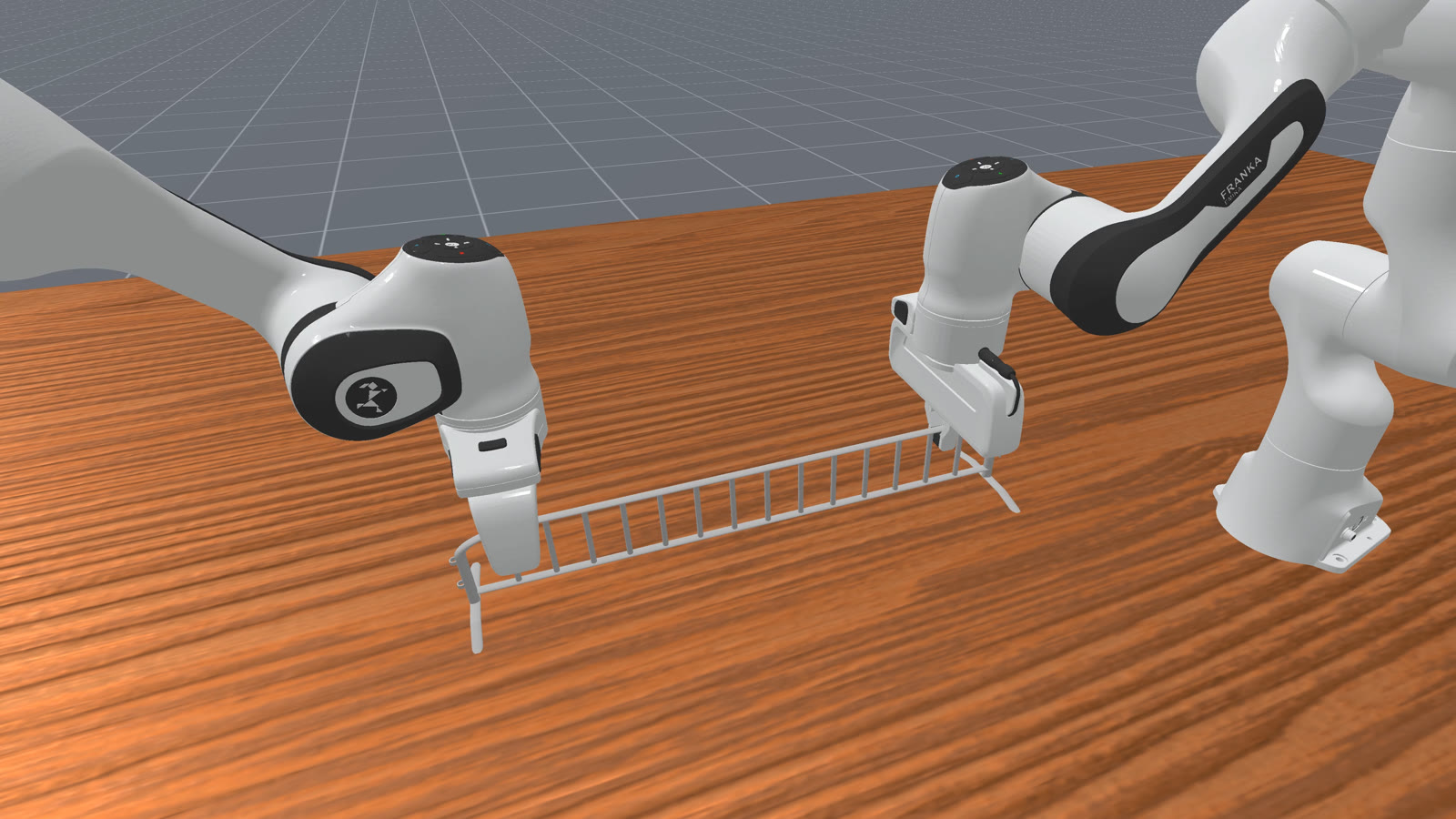
Same start, two choices

Judged by its own motion, the default action is not worse. It becomes worse once the teammate's reaction counts.

Initial configuration
Same initial configuration
Outcome of the default action
Outcome of the CARE selection

Method

Predict what the response contributes, then act on it with a calibrated bound.

  1. 01

    Propose

    A predictive belief encoder learns the interaction from local history and conditions the nominal action u0. The encoder and action generator are then frozen. K = 6 candidates include this nominal chunk and local behavioral alternatives such as waiting, retreating, and slowing down.

  2. 02

    Label with paired interaction augmentation

    From a common state, each candidate is compared with the nominal action under two teammate behaviors: reactive teammates keep running their policies, replay teammates re-issue the commands recorded under the nominal action. The reactive contrast is the total advantage Ak, the replay contrast is the direct advantage Dk, and their difference Rk is the response label. The demonstrations stay in the training set.

  3. 03

    Select with a calibrated lower bound

    A candidate-conditioned response readout uses the frozen predictive representation to predict quantiles of D, R and A plus an adverse-event probability for every candidate. Conformal calibration on held-out families turns the lower quantile of A into a lower bound. The best feasible alternative runs only if its bound clears the margin; otherwise the robot keeps u0. Execution uses local history only, with no rollouts.

same state,
same seed
Nominal action u0
Candidate uk
Reactiveteammates respond
Y0Rpartner reacts to u0
YkRpartner reacts to uk
Replayrecorded commands
Y0Ppartner replays its trace
YkPpartner replays its trace

One paired contrast, three labels

Utility U is a fixed weighted sum of progress, success, time to success and coordination penalties over a 16-step horizon. Collisions and drops are supervised separately as adverse events.

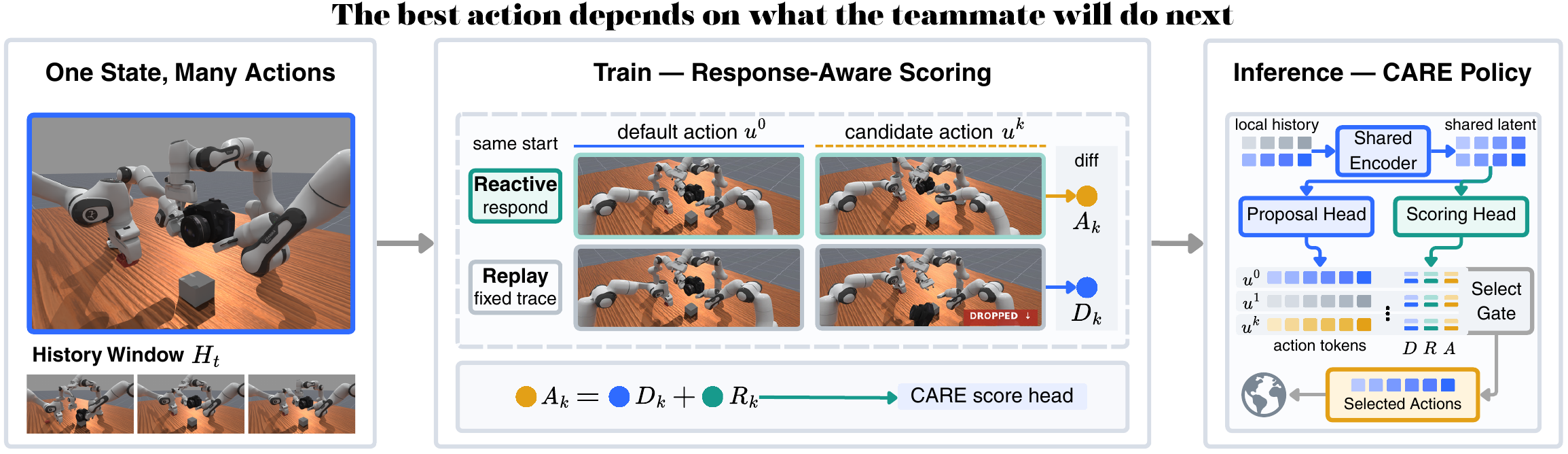
From the same local history, CARE compares candidate and nominal actions under reactive and replayed teammate behavior during training; at execution, local predictions inform candidate selection with calibrated fallback.
Before acting, predict what teammate response contributes. From the same local history (left), CARE compares candidate and nominal actions under reactive and replayed teammate behavior during training (center). The difference between total advantage Ak and direct advantage Dk supplies the response label Rk. At execution (right), local predictions of this contribution inform candidate selection, with calibrated fallback to the nominal action. Full size ↗
CARE architecture: predictive belief encoder, action proposals, candidate-conditioned response readout, and calibrated selector.
CARE architecture. The predictive belief encoder represents local history and conditions the nominal action. Paired interaction augmentation supervises direct advantage D, response interaction R and total advantage A in a candidate-conditioned response readout. The encoder and action generator are frozen during response learning. Held-out calibration provides the correction used to select a feasible candidate by its total-advantage lower bound, with fallback to u0. Full size ↗

Identifiability

Paired supervision identifies the belief.

Two teammate behaviors can agree on every observed nominal continuation and still respond differently to an untried action, so nominal data alone cannot tell them apart. Matched reactive and replay branches turn Rk into draws from the belief, and the pinball loss recovers its conditional quantiles.

Decision value

Response matters when it flips the best action.

Response information has decision value Γ(H) exactly when some candidate's relative response gain exceeds its direct disadvantage. A mean-based belief choice recovers at least Γ − 2e, where e sums the source-fidelity error and the estimation errors of the direct and response means.

Calibrated intervention

Overrides come with coverage.

With exchangeable calibration and test families, the calibrated lower bound covers every candidate's realized advantage with probability at least 1 − α. A released alternative has paired utility above the margin δ on that coverage event. The guarantee concerns the paired reference distribution: source fidelity, exchangeability, and teammates departing from the reference policy at execution can affect deployment.

Results

Strong where the preferred action depends on the partner's timing, and honest about where it does not.

Closed-loop success rate

RoboFactory (six tasks, two to four robots) and the MARS Control Track (four hidden-seed tasks). All policies share the same arm-local observations, action interface and control rate.

SR in %, 20 seeded rollouts per task, so single-task SR moves in five-point steps. † adapted to the shared decentralized interface: LatentToM without latent exchange, GauDP without its global Gaussian scene. The CARE row runs the complete recipe including the calibrated selector; the same proposals with the evaluator switched off reach 80.8 on RoboFactory.

On RoboFactory, CARE achieves the highest average success among the evaluated policies. Most of the gain comes from Take Photo and Pass Shoe, where one robot must hold a pose or an object until its partner is in position and where maintaining support and waiting for a partner are central to completion. CARE falls behind on Place Food, Camera Alignment and Long Pipeline Delivery, where precise positioning or a long sequential chain dominates and there is less for the interaction contrast to change. On MARS, absolute performance is low for all policies; most of CARE's margin comes from Strike Cube Hard, whose success depends on a single well-timed joint impact, and CARE is the only policy with any successes on Four Robots Stack Cube.

Physical dual-robot evaluation

Successful trials out of 20 per task. Same local observations, action space, control frequency and task budget for every policy.

The selector-off control retains the predictive encoder and nominal path. Selection adds four successful trials, increasing average success from 82.5% to 92.5%. All CARE arms share a checkpoint and use their own local histories.

CARE, selector off

82.5%

the predictive encoder and nominal path remain active

Physical override rate

5.8%

selection adds four successful trials across both tasks

Folding Bed

20/20

the fold cannot continue until the partner has regrasped

Mechanism studies · fixed proposals

Is it the belief, or just a better policy? Hold the proposals fixed and change one thing at a time.

Ranking matters more than acting often

Fraction of oracle headroom recovered by each selector over the shared candidate set, with its override rate.

Random selection overrides at almost every step and still recovers a seventh of the oracle gain, so useful alternatives exist. CARE overrides at about one step in seventeen, recovers half of the headroom and has the lowest regret.

Explicit response supervision helps

Response mean absolute error, lower is better. The table reports the snapshot split and deployed seed. Total-only and Direct-only have no response predictor and are omitted from this error chart. All variants share proposals, representation, paired data, and selection rule.

Explicit response supervision improves ranking agreement from 0.603 to 0.671 and reduces regret from 0.0061 to 0.0048 relative to information-matched branch-utility supervision. Response MAE uses the response median for CARE variants and contrasts of marginal medians for A+D and branch utilities; medians do not commute with subtraction.

Calibration turns interventions into gain

Closed-loop success against override rate for selection rules that share the same trained scorer.

Acting on the posterior mean overrides at almost every step and cuts success nearly in half. An uncalibrated lower quantile still finishes below the nominal path. Candidate-wise calibration reaches the highest success while overriding at one step in six; the simultaneous family-wise rule keeps five of those points while overriding a third as often, and it is the rule with the coverage guarantee. The safety filter changes neither rate.

Simulation · RoboFactory

Six collaborative tasks, two to four robots, one shared policy.

Each arm receives only its own RGB history, proprioception, executed-action history and the shared task instruction. Teammate observations and simulator state are never available at execution. Frames are numbered in temporal order; the badge is CARE's closed-loop success over 20 rollouts.

MARS Control Track (hidden seeds, trained on its own 600 demonstrations): Place Cube in Cup 15% · Strike Cube Hard 95% · Three Robots Place Shoes 10% · Four Robots Stack Cube 20% · average 35.0%, the highest of all nine policies.

Real robots

Holding and waiting for the teammate is part of the correct action.

Frozen policies evaluated on two physical two-robot tasks against ACT and π0.5. Both robots run the same CARE weights from their own observations. The advantage appears where the task cannot continue until the partner is ready, and shrinks where single-arm manipulation dominates.

Folding Bed · 20/20

Two robots fold a quilt in two passes.

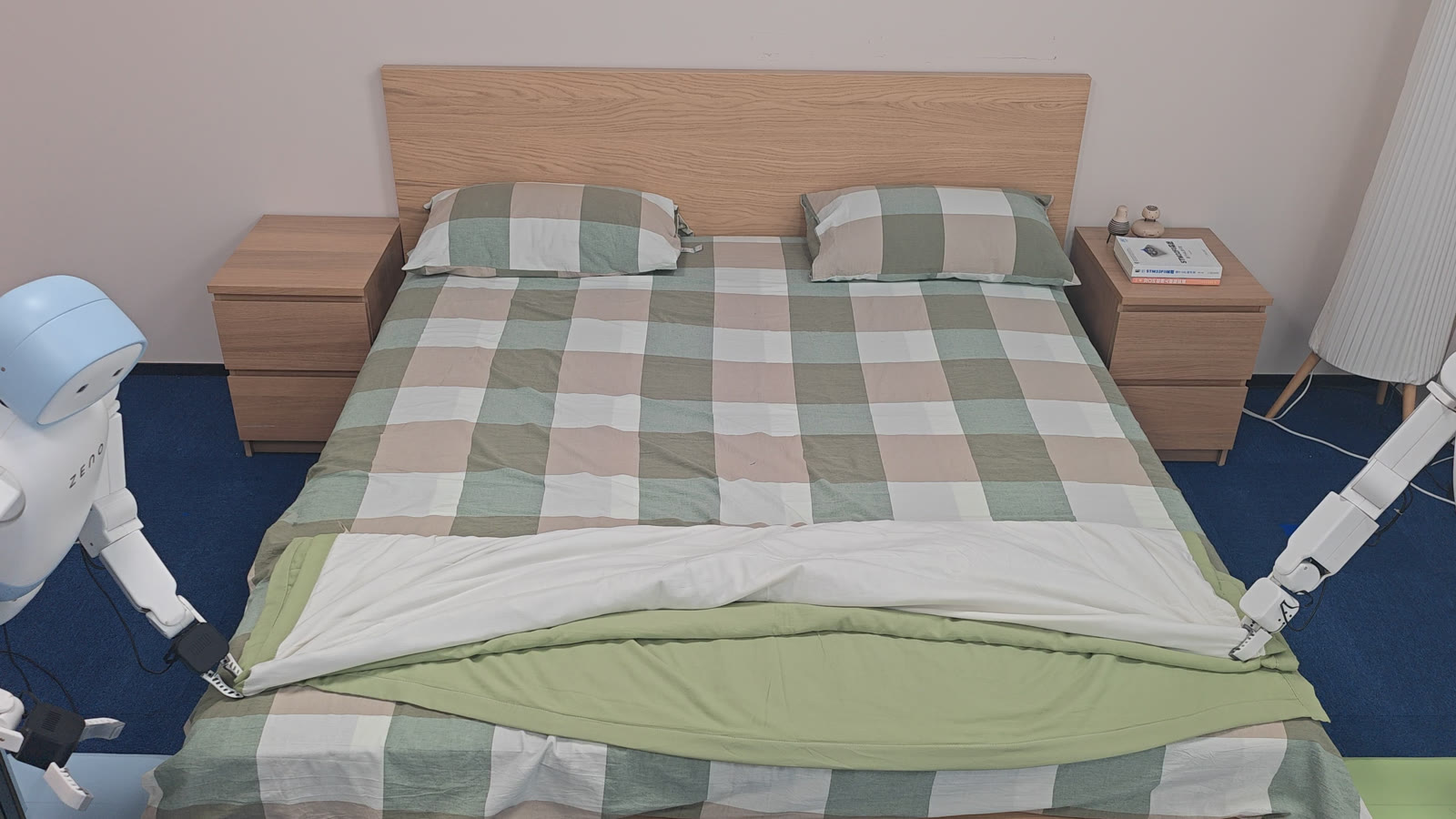
The robots grasp the quilt edge, pull it over for the first fold, then regrasp for the second. One arm holds its edge and waits while its partner approaches and regrasps before the next fold. ACT succeeds in 12 of 20 trials and π0.5 in 9.

  • both robots grasp the quilt edge
  • first fold
  • blue holds the folded edge and waits while green regrasps
  • second fold

Opening Box · 17/20

Open the box, retrieve the target, put it down.

The left arm opens the lid; the right arm takes over supporting it and waits while its partner grasps the target inside and places it on the table. π0.5 is comparatively strong here (14 of 20), and this is where CARE's few failures occur.

  • left arm opens the lid
  • right arm takes over the lid and waits
  • left arm reaches in and grasps the target
  • left arm lifts it out and places it

Opening Box

  1. left opening the box
    right waiting beside the box

  2. left grasping the target
    right supporting & waiting

  3. left placing the target
    right supporting & waiting

  4. left moving back to home
    right moving back to home

Folding Bed

  1. blue grasping the quilt
    green grasping the quilt

  2. blue moving to fold
    green moving to fold

  3. blue waiting for green
    green approaching & regrasping

  4. blue moving to 2nd fold
    green moving to 2nd fold

manipulating · supporting or waiting · moving

Scope and limitations

Team-response beliefs depend on what the local history reveals about the partner, on which actions are available and on how team utility is measured. Weak proposals leave little gain to recover, and a short horizon can miss delayed reactions. The paired contrast depends on the nominal trace and may put replayed teammates in states that never occur in ordinary interaction, so augmentation bias, unseen partners and policy-induced distribution shift can affect both belief accuracy and calibration. CARE already conditions nominal actions on predictive beliefs. Future work can adapt proposal distributions, extend response learning to changing teammate policies, and combine selection with runtime monitoring.

BibTeX

@misc{li2026beforeweact,
  title  = {Before We Act: Learning Action-Conditioned
            Team-Response Beliefs for Decentralized
            Multi-Robot Manipulation},
  author = {Li, Zihao and Zhou, Yanan and Qiu, Ranpeng and
            Ren, Guoqiang and Zhi, Weiming},
  year   = {2026},
  note   = {Preprint},
  url    = {https://jeong-zju.github.io/care/}
}